Как я превратил свой бизнес в машину продаж с помощью ИИ

Share this article:
My name is Denis Futurist, and today I want to share with you a story about how artificial intelligence completely transformed my sales funnel and allowed me to scale my business without crazy amounts of time and resources.
Why regular sales funnels stopped working
We now have an incredible secret weapon at our disposal - artificial intelligence and automation. They allow us to expand our capabilities without having to hire more employees.
Let me explain why AI has become a real breakthrough in sales. Imagine having a virtual assistant who never sleeps, never gets tired, never takes time off, and can simultaneously conduct conversations with hundreds of potential clients. At the same time, he remembers absolutely all the details of previous conversations, instantly analyzes the interests of the interlocutor and adapts to his communication style.
Two years ago, my team managed leads through spreadsheets. Imagine: a manager opens a Google Sheet every day, manually checks statuses, writes comments, and schedules calls. When the lead didn't respond, I had to make a note and get back to him later. All this took an enormous amount of time. If someone from the team went on vacation, some of the leads simply “stuck” without moving. With an increase in traffic, the system simply stopped coping - managers physically did not have time to process all requests, and valuable leads simply went to competitors.
Do you recognize your business in this description? Perhaps right now your managers are sitting over Excel spreadsheets, trying not to miss important contacts, and you are wondering how to manage all this chaos while growing volumes? Then read on - I have a solution that has completely changed the way we approach sales!
.webp)
AI is the secret weapon in sales
We now have an incredible secret weapon at our disposal - artificial intelligence and automation. They allow us to expand our capabilities without having to hire more employees.
Let me explain why AI has become a real breakthrough in sales. Imagine having a virtual assistant who never sleeps, never gets tired, never takes time off, and can simultaneously conduct conversations with hundreds of potential clients. At the same time, he remembers absolutely all the details of previous conversations, instantly analyzes the interests of the interlocutor and adapts to his communication style.
In our company, we have implemented several types of AI systems for different stages of the funnel:
- Qualification AI - determines how well a lead matches our target audience
- Communication AI - conducts dialogues through instant messengers and email
- Analytical AI - deciphers and analyzes calls with clients
- Predictive AI - estimates the likelihood of closing a deal
Here's what has changed radically in our work since the introduction of AI:
Anatomy of a Perfect AI Sales Funnel
Now I will show you step by step what happens in our system. If you find that you are not doing something from this list, then this system is definitely for you!
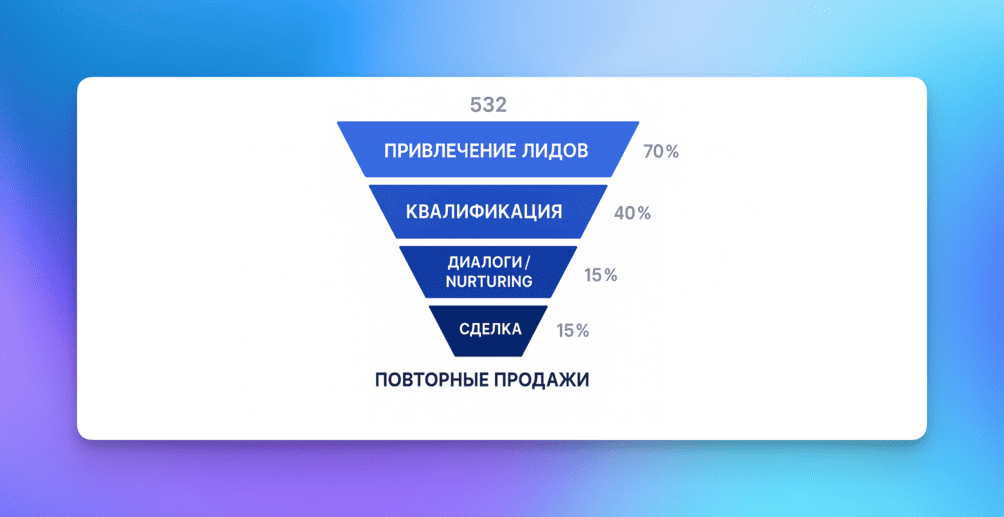
1. Attracting and qualifying leads
When a potential customer encounters our advertising or content, they are taken to a sales page. There we talk about what we do, who we help, what results our clients get.
Thanks to this approach, even if a person does not complete the survey, we can already contact him. This is one of the reasons why our calls are so cheap and effective - we don't lose leads along the way.
Instead of immediately offering to book a call, we conduct qualification using an interactive survey. Already in the first step we collect phone number, email and name.
2. Instant contact with AI
This is where the real magic begins! Once someone enters our funnel, our AI agent contacts them within the first minute via WhatsApp or SMS. Why is the minute so important? Research shows that the likelihood of a lead converting decreases by 80% if the first contact occurs later than 5 minutes after his request. Our system is set up so that even if the application arrives at 3 am, the client receives an instant response.
Here's how it works in practice. Recently, Mikhail, the owner of a furniture manufacturing company, contacted us. He completed the qualification survey at 10:47 p.m. Exactly 45 seconds later, he received a message on WhatsApp: “Hello, Mikhail! Thank you for your interest in our solutions for the furniture business. What is more important for you now: increasing the number of orders or optimizing the process of processing existing requests?”
Unlike the traditional lead magnet approach, where you just send a PDF and hope the customer reads it, we start an active conversation. Our AI asks personalized questions based on data from the survey. For manufacturing companies this is one set of questions, for the service industry - another, for educational projects - a third.
For example, for B2B clients, our AI asks: “What is more valuable to you: a sales funnel for 100 thousand people or an AI system that registers qualified calls?” But for companies in the service sector, the question is different: “What is more critical for your business now: increasing the number of new clients or increasing the average bill?”
This allows the potential client to ask for exactly the type of information they really need. In the case of Mikhail, he replied that optimizing request processing is more important to him, since he already has a flow of clients, but the team cannot handle the processing. The algorithm immediately determined that Mikhail is the ideal candidate for our premium solution.

- Increase SEO traffic
- Content Marketing
- Effective paid strategies
3. Smart call booking system
clients book calls without transitions and unnecessary actions
More detailsOnce qualified, the AI offers a sales call. Important: There is no need to send the client to another page or fill out another form. The AI simply sends the booking link.
We have eliminated the main barrier - the need to navigate to other pages or fill out additional forms. In traditional funnels, the customer completes a survey, then is redirected to a calendar page where they must fill out all their details again. At each such transition, we lost 20-30% of potential clients.
Our AI agent communicates with the client directly via WhatsApp or SMS and, having determined that they are ready for a call, sends a personalized link for booking. The client does not need to re-enter his data - the system already knows his name, email and phone number from previous interactions.
After booking, the bot asks if there is anything specific the customer would like to focus on during the call. This allows us to be better prepared and increases the value of communication.

- I share real stories of AI implementation in business
- I post working scripts, templates and funnels
- I analyze the mistakes of entrepreneurs and provide ready-made solutions.
4. System against "no-shows"
One of the most painful moments in sales is when a client makes an appointment for a call but doesn't show up. The industry average for no-show rates is between 30% and 50%. Imagine: you prepared for a conversation, allocated time, and the person simply did not show up. This is not only wasted time, but also missed opportunities.
Our call turnout rate is over 90%! And this is not an accident or luck - it is the result of a carefully thought out system. I'll tell you a few secrets about how we achieved this:
Thank you page with a clear action plan
After booking, the client does not just see the standard “Thank you for booking”, but is taken to a special page with step-by-step instructions.
This page creates a micro-commitment - the client has already invested time in preparation, so the likelihood that he will “forget” about the call is significantly reduced.
For example:
Multi-channel reminder system
We use all available communication channels to remind you about the call:
- 24 hours in advance: email with detailed information about the call
- 4 hours in advance: WhatsApp message asking to confirm the meeting
- In 30 minutes: SMS with a link to call
An important point: all these messages are sent not on behalf of the robot, but from a real person - the very specialist who will conduct the call. This creates a personal connection and increases accountability.
Warm-up sequence with valuable content
Days before the call, the client receives a series of materials that help him better understand the value of the upcoming conversation:
We carefully select content based on data from the survey and preliminary communication. For retail trade - some materials, for the B2B segment - others.
5. “Summary of understanding” after the call
After the call with our sales specialist, another magic happens. We use an AI tool called Fathom that joins every call and analyzes its content in real time.
What is a “summary of understanding”? This is not just a formal report of the conversation, but a personalized document that shows the client: “We heard you, understood your situation and here is what we can offer.” This tool has been a real breakthrough in our sales process.
Automatic call recording and transcription
Fathom (or any other similar tool) joins our Zoom or Google Meet call as a participant. It records the entire conversation and creates a detailed transcript in real time.
When a manager speaks with a client, he does not need to be distracted by notes or notes - AI does all this work for him. The manager can fully focus on conversation, active listening and relationship building.
AI analysis of key conversation points
After the call, artificial intelligence automatically analyzes the entire transcription and highlights:
- The client’s main problems and pain points (in his own words!)
- Objections and doubts that were expressed
- Specific needs and requests
- Mentions of competitors and alternative solutions
- Current processes in the client's company
- Key decision makers
For example, for the head of a real estate agency, the AI identified the following problems: “Managers spend 40% of their time filling out the CRM”, “Reporting takes a whole day a week”, “It is difficult to track the effectiveness of different channels for attracting clients”

- What is included in the implementation service
- Startup steps AI-systems
- Examples of customization for different niches
- Results from our clients
Generation of a personalized document
Based on this analysis, the system generates a multi-page personalized document that includes:
- The client’s main problems and pain points (in his own words!)
- Objections and doubts that were expressed
- Specific needs and requests
- Mentions of competitors and alternative solutions
- Current processes in the client's company
- Key decision makers
For example, for the head of a real estate agency, the AI identified the following problems: “Managers spend 40% of their time filling out the CRM”, “Reporting takes a whole day a week”, “It is difficult to track the effectiveness of different channels for attracting clients”
The document is sent to the client within 15-30 minutes after the end of the call - while the conversation is still fresh in his memory. This makes a strong impression and shows our level of service.
After a call with the director of the online school, we sent a resume in which we discussed in detail his problem with a high percentage of payment refusals after a trial lesson. In the document, we not only proposed our solution, but also included specific scripts for teachers to implement immediately. The director was so impressed by the depth of the analysis that he signed the contract the very next day, even without a second call.
Personalized options for further actions
In this document we have several "calls to action":
- Possibility to sign up for a second call for a more detailed discussion
- Ability to request a demo of a specific aspect of our solution
- Ability to immediately proceed to payment and start cooperation
- Form for additional questions that might arise after the call
All of these options are integrated with our CRM and automation system, so when a client selects any of these options, the corresponding automation is triggered immediately.
- Increase in conversion after the first call by 37%
- Reducing the sales cycle from 14 to 8 days on average
- Increase in average bill by 28% due to better understanding of customer needs
- Improved Customer Satisfaction Score (CSAT) from 4.2 to 4.8 out of 5
Even if the client is not ready to buy right away, this document creates a strong emotional connection and is often the deciding factor when the client compares us to competitors. Several clients have said that they chose us because of this personalized approach, even when competitors had lower prices.
Real results we got
therefore, I will share with you the exact numbers and metrics that have changed since the implementation of our AI system. These are not theoretical predictions or rough estimates - these are real data from our CRM over the last 6 months.
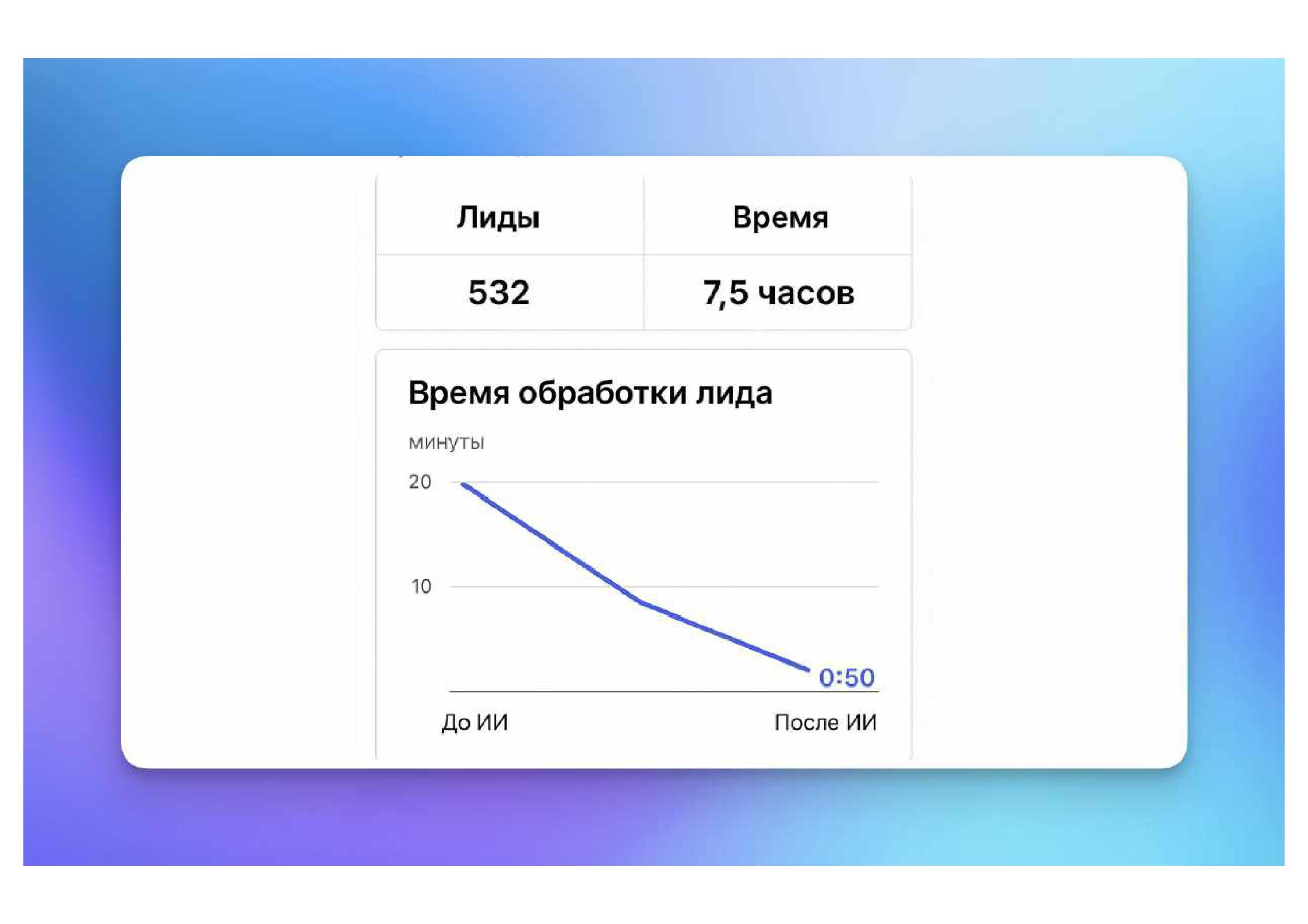
1. The cost of acquiring a lead decreased by 63%
Before the introduction of AI: We spent an average of 135 rubles per booked call. After the introduction of AI: Now we pay about 50 rubles.
Why did this happen? Not only due to better qualifications, but also due to the fact that the AI system “rescues” leads who did not initially book a call. Previously, such leads were simply lost, now our AI enters into dialogue and converts them into calls.
In July, we received 167 applications through advertising, of which only 48 immediately booked a call. But thanks to the work of AI, 54 more people later agreed to talk. This increased the effectiveness of the advertising budget by more than 2 times!
2. Call turnout rate increased from 40% to 90%
Before the introduction of AI: Out of 10 booked calls, only 4 took place. After the introduction of AI: Out of 10 booked calls, 9 took place.
This is a huge difference! Every ruble spent on advertising now works much more efficiently. If earlier out of a 100,000 ruble advertising budget we received 30 completed calls, now we receive more than 90.
Last month, 35 calls were scheduled. Only 3 did not take place - and then for objective reasons (one client got sick, the second had urgent work circumstances, the third honestly warned that he would not be able to attend, and rescheduled the meeting).
3. Time spent on the processing of leads decreased from 25 to 2 hours per week
Before the introduction of AI: The processing of leads and preparation for 30 calls took 25+ hours of team work. After the introduction of AI: Now the same volume requires only 2 hours of human intervention.
At the same time, we process from 26 to 35 calls weekly! What does this mean for business? Firstly, savings on managerial salaries - we did not have to hire additional employees when the number of leads grew. Secondly, the existing team can focus on more important tasks.
Calculation of savings: if the average salary of a customer service manager is 60,000 rubles per month, then by reducing time costs (from 100 to 8 hours per month) we save approximately 45,000 rubles monthly.
4. Sales conversion increased by 42%
Before the introduction of AI: 18% of clients with whom we conducted a call became our clients. After the introduction of AI: Now this figure is 25.6%.
This happened due to several factors:
- Better lead qualification at the call booking stage
- Deeper understanding of customer needs through upfront communication with AI
- Personalized call preparation based on collected data
- A “Summary of Understanding” that solidifies the agreement after the call
In the online school segment, our conversion rate reached a record 34%, which is almost 3 times higher than the industry average (12%).
5. The average check increased by 28%
It was an unexpected but pleasant bonus! Thanks to a better understanding of client needs, our managers have become more effective in offering additional services and higher-level options.
Before the introduction of AI: The average bill was 87,000 rubles. After the introduction of AI: Now the average bill is 111,360 rubles.
A client from the consulting industry was initially interested in the basic automation package (75,000 rubles). But in the process of communicating with AI, he mentioned problems with analytics and reporting. This information was transferred to the manager, who offered an extended package with an analytics module (150,000 rubles). The client agreed because it solved his specific problem.
How to implement this system in your business
I want to be completely honest with you: implementing AI in sales is not an overnight process. It took us about 4 months to debug all processes and achieve stable results. But every step of this path has paid off handsomely.
If you want to create a similar system, I offer a step-by-step plan that we ourselves used. I have broken it down into specific stages with approximate deadlines for implementation:
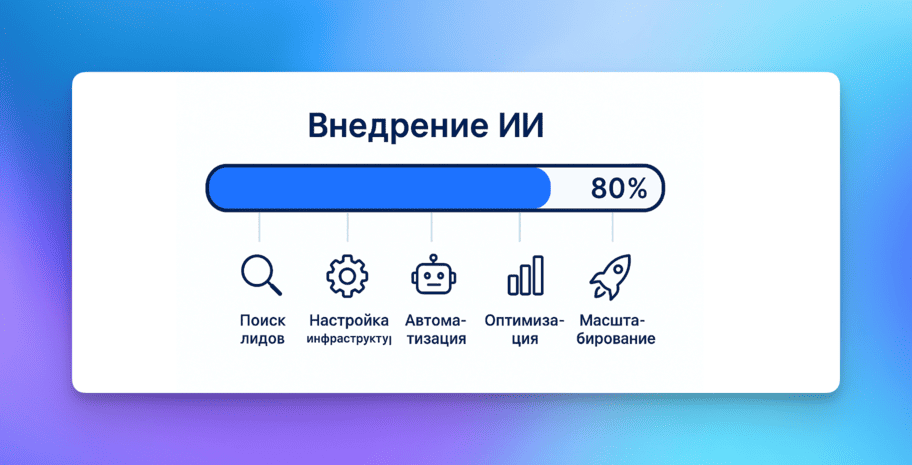
Fifth Main Block - Stage 1
Identify the key points of your sales funnel
Start by analyzing the entire customer journey: from the first contact to the closing of the transaction. Where is manual intervention required now? What processes can be automated?
Practical tip: Create a table with columns “Stage”, “Current Process”, “Time Cost”, “Automation Opportunity (1-10)”. Rank all tasks according to the possibility of automation and start with those with a score of 8-10.
We found that managers spent 68% of their time sending standard reminders and answering standard questions. These processes scored 10 on the automation scale and became our priority.
Stage 2: Basic infrastructure (2-4 weeks)
Identify the key points of your sales funnel
Technical implementation: We use the combination Tally.so to create shapes and Zapier for integration with our CRM-system. Important point: set up automatic lead segmentation based on their responses.
— everything is automated from the first qualification step
More detailsDevelop a smart survey that not only collects data, but also qualifies leads. Key strategy: collect contact information (name, email, phone) at the very first step, before the client answers all questions.
Advanced tip: Create multiple versions of the survey for different acquisition channels. Leads from Instagram may see different questions than those coming from Google Ads, as their intent is often different.
Example of questions for qualification:
- "What is your company's annual turnover?" (segmentation by business size)
- "What automation tools do you already use?" (assessment of technical readiness)
- "When do you plan to implement the new solution?" (determining the urgency of the need)
- "Who makes the final purchasing decision?" (identification of decision makers)
Set up instant communication through AI
Implement a system that will contact leads within the first minute after submitting an application. Choose a communication channel depending on your audience: WhatsApp works great for B2B, SMS for a general audience, Telegram for tech-savvy clients.
Technical solutions: We use ChatGPT API to create personalized messages and WhatsApp Business API for automatic sending. Alternatives: ManyChat, Landbot or Twilio.
Create a library of typical communication scenarios for different customer segments. Start with 3-5 basic scenarios and gradually expand them by analyzing real dialogues.
Stage 3: Automation of communications (3-4 weeks)
Create a lead warming system
Develop a sequence of messages that will be sent to the client before the call. Combine different types of content: text, video, infographics, cases.
Technical solutions: We use ActiveCampaign for email sequences and Twilio for SMS and WhatsApp. We integrate them with our CRM via Zapier.
Sequence structure:
Set up different sequences depending on the urgency of the need. For “hot” leads, compress the entire cycle to 1-2 days; for “warm” leads, extend it to a week.
Introduce AI to analyze calls
Use transcription and call analysis technologies to create personalized “insight summaries.” This is a goldmine for increasing conversions after the first contact.
Technical solutions: We use Fathom or Gong.io to record and analyze calls. We integrate them with the ChatGPT API to create personalized resumes.
Structure of a “summary of understanding”:
- A brief overview of the client's business (based on what they said)
- Identified problems and pain points
- Solutions you suggested
- Specific next steps
- Additional materials on topics that interested the client
After a call with the owner of a dental clinic, our AI identified three key problems: a high percentage of patient no-shows, difficulties with repeat sales, and ineffective work of administrators. In the summary, we focused specifically on these problems, proposing specific modules of our solution for each of them.
Stage 4: Process optimization (ongoing)
Automate the process of reminders and confirmations
Add an element of personalization to every reminder. For example, “By the way, I looked at your site and came up with some ideas for improving conversion” - this significantly increases the likelihood of turnout.
Add an element of personalization to every reminder. For example, “By the way, I looked at your site and came up with some ideas for improving conversion” - this significantly increases the likelihood of turnout.
Leave human participation only at key points
Identify where human interaction is truly essential and focus team resources there.
In our system, people participate only at three points:
- Strategy for attracting traffic (analysis of channel effectiveness, advertising optimization)
- Conducting sales calls (where empathy and flexibility of thinking are critical)
- Onboarding of new clients (initial setup and training)
All other processes are automated or delegated to AI.
Start by automating 20% of the tasks that take up 80% of your team's time (Pareto principle). This will give quick results and free up resources for further optimization.
- I share real stories of AI implementation in business
- I post working scripts, templates and funnels
- I analyze the mistakes of entrepreneurs and provide ready-made solutions.
Combine all elements into a single ecosystem
Integrate all the components of your system into a single whole, where data flows freely between different tools.
Technical solutions: Choose a central CRM system (we use HubSpot or Pipedrive) and integrate all other tools with it.
Key integrations:
- Qualification forms → CRM → Communication system
- Booking calendar → CRM → Reminder system
- Call recording system → AI analysis → Resume generation
- CRM → Analytical system → Performance dashboard
Create a visual map of all integrations and data flows. This will help identify potential problems and optimize your system architecture.
Constantly train and improve your AI
AI gets better with every interaction if the learning process is done correctly.
Regular actions:
- Weekly analysis of AI conversations with clients (especially those where the client did not respond or was unhappy)
- Adjusting scripts and prompts based on collected data
- Adding new scripts for frequently asked questions
- A/B testing of different message formats
All other processes are automated or delegated to AI.
We noticed that the AI was too quick to suggest booking a call, which was turning off some customers. We modified the script to include an intermediate step providing valuable information, and booking conversions increased by 18%.
Work smarter, not harder
If you're still managing your leads manually in 2025, you're at a disadvantage. In the era of artificial intelligence, it's like trying to compete in the modern world using technology from the last century.
When I started my business, I was sure that the “human factor” in sales is irreplaceable. We were proud that every message was written by a real person, every call was carried out with an individual approach. But behind this romantic notion was a harsh reality: our team was burning out, we were losing leads, and scaling was a huge challenge.
If you're still managing your leads manually in 2025, you're at a disadvantage. In the era of artificial intelligence, it's like trying to compete in the modern world using technology from the last century.
When I started my business, I was sure that the “human factor” in sales is irreplaceable. We were proud that every message was written by a real person, every call was carried out with an individual approach. But behind this romantic notion was a harsh reality: our team was burning out, we were losing leads, and scaling was a huge challenge.
Today, looking back, I realize how naive my approach was. AI has not replaced the human factor—it has enhanced it. Our managers no longer waste time on routine tasks, but focus on what really matters: building relationships, solving complex customer problems and strategic thinking.
Here are a few key lessons I learned from our transition to AI automation:
AI in sales is not just a buzzword or a passing fad. This is a fundamental change in the way businesses interact with customers. These technologies have already transformed entire industries, and the process is only accelerating.
I remember how one of our first clients after implementing the AI system asked:
“How do you manage to answer all my questions so quickly? Do you have a whole call center?” When I explained to him that most communication is done by AI, he was amazed: “I didn’t even notice the difference. And that’s great.”
This is what we should all be striving for: using technology in a way that is subtle but makes every interaction more valuable, timely, and personalized.
Start implementing these tools gradually, and you will be surprised how much more efficient your sales funnel will become. And if you need more detailed advice or help setting up your own AI system, I’m always ready to share my experience - just contact me through my website or social networks.
Remember: in a world where technology is constantly evolving, success comes to those who not only work harder, but work smarter.
Success in sales automation and see you next time!

Did you like the article? Share with a friend.
